

If you're considering a hair transplant in Türkiye, you've probably come across two acronyms again and again: Sapphire FUE and DHI. They are the two flagship techniques offered by Turkish clinics, and together they represent one of the widest menus of surgical hair restoration available anywhere in the world. But what actually separates them? And how do you know which one suits your hair and your lifestyle?
The short answer is that neither is universally “better.” Türkiye's experienced surgeons are fluent in both, and they choose between them — or combine them — based on the quality of your donor area, the pattern of your hair loss, and the result you're hoping for. This guide explains the differences in plain language, so you can walk into your consultation feeling informed rather than sold to.
Two Techniques, One Goal: Natural, Permanent Density
Before comparing the methods, it helps to understand what they share. Both Sapphire FUE and DHI are forms of follicular unit extraction. That means individual hair follicles — or tiny groups of one to four hairs — are removed from a donor zone (usually the back and sides of the scalp) and relocated to thinning or balding areas. Because these donor follicles are genetically resistant to the hormone that causes pattern baldness, they keep growing for life once transplanted.
Both techniques are minimally invasive, performed under local anaesthesia, and leave only tiny dot-like marks rather than a linear scar. Both are considered permanent solutions, and both can be used for the hairline, the crown, the mid-scalp, or even eyebrows and beard areas.
So the difference isn't about whether the hair will grow — it's about how the follicles are prepared, how they're placed, and what that means for your day-to-day experience of the procedure and the recovery period.
Sapphire FUE: The Precision Blade That Changed Everything
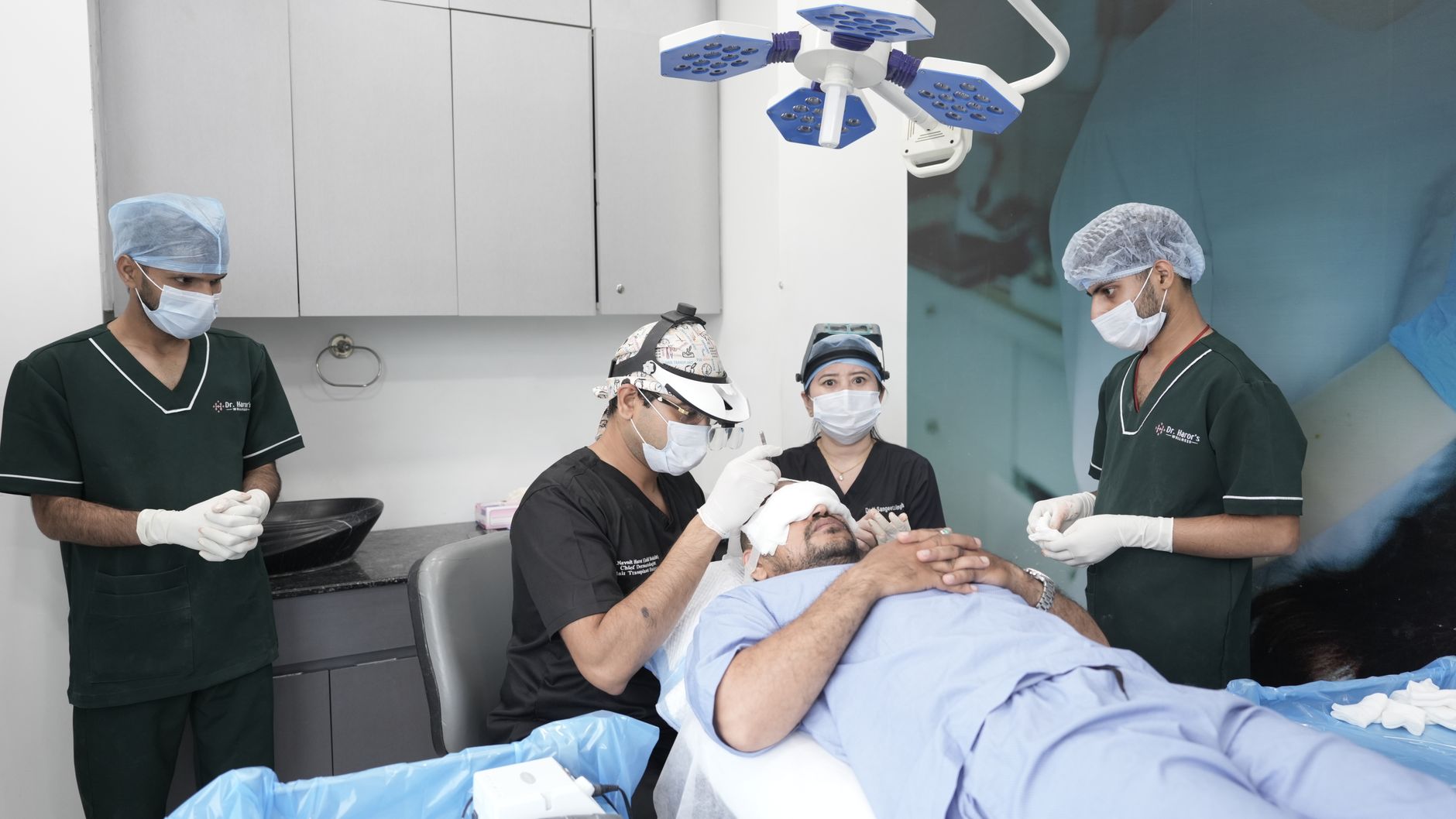
Sapphire FUE gets its name from the tiny sapphire blade used to open the recipient sites — the small channels where grafts will be planted. Unlike traditional steel blades, sapphire blades are incredibly fine and sharp, which allows surgeons to create narrower, cleaner incisions.
What does that mean for you? Narrower incisions cause less trauma to the scalp, which typically translates into faster healing, less scabbing, and a more comfortable recovery. The sapphire blade also lets the surgeon control the angle and direction of each channel with great precision, which is essential for creating a natural-looking hairline that matches the way your existing hair grows.
Sapphire FUE is also efficient. Because the channels are pre-opened before grafts are placed, teams can often move quickly, which makes it a good fit for larger sessions — sometimes 3,000 to 5,000 grafts in a single day. If you have significant baldness across a broad area, this efficiency can be a real advantage.
What a Sapphire FUE Session Looks Like
A typical Sapphire FUE session lasts six to eight hours, including breaks. The day usually starts with mapping your new hairline, followed by local anaesthesia, then extraction of donor follicles, then the opening of sapphire channels, and finally the placement of grafts. Most clinics divide the work between a surgeon and a trained team, with the surgeon overseeing the critical steps.
Because the incisions are tiny, most patients find the recovery relatively smooth. Redness and small scabs appear in the recipient area and fade within a week to ten days. Many people are back to desk work or light activity within two to three days, though you'll want to avoid strenuous exercise, swimming, and direct sun on the scalp for a couple of weeks.

DHI: The Choi Pen and the Art of Dense Packing
DHI stands for Direct Hair Implantation. Instead of opening all the channels first and placing grafts afterwards, DHI uses a specialised tool called a Choi pen. The follicle is loaded into the pen and implanted directly into the scalp, one at a time, with the depth, angle, and direction controlled in a single motion.
This one-step approach has a few practical consequences. Because the graft is placed immediately after extraction and never sits outside the body for long, some surgeons believe it stays fresher — though the evidence on graft survival is debated, and both techniques produce good results in skilled hands. More importantly, DHI gives the surgeon extreme control over angle and direction, which is why it's often chosen for the hairline, where a single badly angled graft can look unnatural.
DHI is also capable of very dense packing. Because there are no pre-made channels to work around, the surgeon can place grafts close together in a small area, creating a fuller look in a targeted zone. That makes DHI a favourite for patients with smaller bald patches, early-stage thinning, or those who want to reinforce a specific area like the temples.
What a DHI Session Looks Like
DHI sessions often run longer than Sapphire FUE — sometimes eight to ten hours or more — because each graft is implanted individually. This is one reason DHI is often recommended for smaller sessions, typically 1,500 to 3,000 grafts. For very large areas, a surgeon might combine DHI at the hairline with Sapphire FUE in the crown, getting the best of both worlds.
Recovery after DHI is similar to Sapphire FUE, but many patients report less bleeding and less crusting because there are no open channels waiting for grafts. The tiny punctures heal quickly, and the same rules apply: no heavy sweating, swimming, or sun exposure for the first couple of weeks. Because the Choi pen creates very small entry points, some patients find the first few days after DHI particularly comfortable.
Incision Method, Density, Session Length and Recovery: A Side-by-Side View
Let's pull the key differences into focus. Incision method: Sapphire FUE uses a sapphire blade to open channels before placement; DHI uses a Choi pen to implant directly, with no pre-opened channels. Density potential: both can achieve high density, but DHI's direct placement allows very tight packing in small areas, while Sapphire FUE's efficiency shines in large, diffuse areas. Session length: Sapphire FUE is typically faster (6–8 hours) and better suited to mega-sessions; DHI is slower (8–10+ hours) and usually used for smaller, precise sessions. Recovery: both are minimally invasive with similar downtime, but Sapphire FUE may involve slightly more scabbing, while DHI often means less bleeding and crusting.
It's worth noting that these are tendencies, not rules. A skilled surgeon can achieve impressive density with either technique, and the final result depends far more on donor quality, graft handling, and surgical skill than on the tool alone. That's why the most important question isn't “Which technique is best?” but “Which technique is best for me?”
In Türkiye, well-run clinics don't push one technique. They assess your donor area, your pattern of loss, and your lifestyle, then recommend the approach — or combination — that gives you the most natural, lasting result.
That assessment usually includes a trichoscopic examination of your donor zone, a discussion of your hair-loss history and family patterns, and a conversation about how much downtime you can afford. If you have a dense donor area and a large bald patch, Sapphire FUE might let you cover more ground in one session. If your donor area is more limited or your loss is concentrated in the hairline, DHI's precision and dense packing could be the smarter play.

Why Türkiye Excels at Both — and Why That Matters for You
Türkiye has become a global hub for hair restoration for good reason. Istanbul alone performs hundreds of thousands of procedures each year, and the country's experienced surgeons have trained extensively in both Sapphire FUE and DHI. Many clinics use both techniques daily, which means their recommendations are based on clinical fit rather than on which method they happen to offer.
This breadth of choice is genuinely good news for patients. It means you're not forced into a one-size-fits-all package. Instead, you get a personalised plan: perhaps Sapphire FUE for the crown and DHI for the hairline, or a single technique chosen because it matches your donor density and your recovery timeline.
Turkish clinics are also known for their experienced teams, modern operating rooms, and published pricing. But the real advantage is the consultation culture — a good clinic will spend time understanding your goals, show you treatment progress cases, and explain honestly what's achievable. They'll tell you if you're not a candidate, and they'll never promise a result that your donor area can't support.
How to Prepare for Your Consultation
To get the most out of your consultation, come prepared. Bring photos of your hair at different stages, note any medications you take, and be clear about your expectations. Ask the surgeon which technique they recommend and why. Ask how many grafts they estimate, what density they can achieve, and what the recovery timeline looks like. A confident, ethical clinic will welcome these questions.
It also helps to think about your lifestyle. If you have a physically demanding job or a big event coming up, you may prefer the technique with the gentler recovery. If you're travelling from abroad, you might want the technique that allows for a shorter stay. These practical factors matter, and good surgeons factor them in.
Making the Choice: Your Hair, Your Goals, Your Plan
Ultimately, the choice between Sapphire FUE and DHI isn't about hype — it's about alignment. Sapphire FUE offers speed, efficiency, and good results for larger areas. DHI offers precision, dense packing, and fine control for hairlines and smaller zones. Both are proven, both are available in Türkiye, and both can change your appearance for the better.
The key is to choose a clinic that lets your donor quality and goals drive the decision. In Türkiye, that's exactly what experienced surgeons do. They're fluent in both techniques, and they'll guide you toward the one that suits your hair and your lifestyle — not their sales targets.
So if you're planning a hair transplant journey, take heart. You're not choosing between good and bad; you're choosing between two excellent options. With the right surgeon and a personalised plan, you can look forward to a natural, permanent result that fits the life you want to live.
Thinking about treatment in Turkey?
Send us a question about this site or about the information published on it. This is a publisher's mailbox, not a medical service and not a route to a particular provider — for clinical questions, contact your own doctor.